
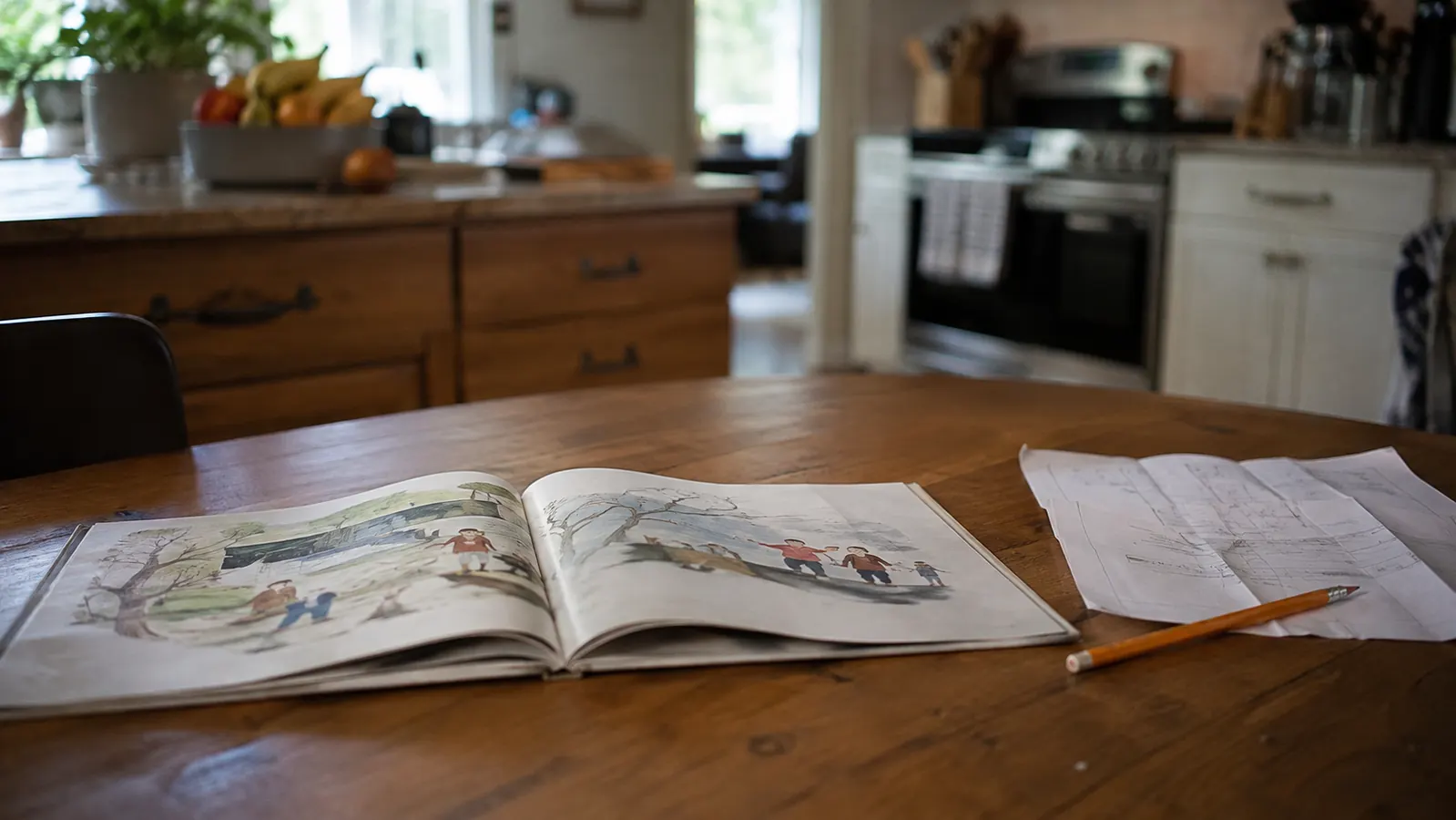
Nora turned six in March, and for most of that school year she had one sentence she used for anything new: "I can't." Not "I don't want to." I can't. It came out in the car, at the kitchen table, at the top of the stairs with one shoe on. Two picture books got used against that sentence in our house, and only one of them was a book I owned. The other came home from the Dayton public library in a canvas bag and went back three weeks later. This is the honest split between The Magical Yet by Angela DiTerlizzi and The Dot by Peter H. Reynolds, from a mom who read both out loud to the same child in the same year, on ordinary weeknights, with the washing machine going.
Short answer first, because that is what I wanted when I was reading pages like this one at eleven at night. The Magical Yet is the one that stayed, and it is the one I would buy again. The Dot is the better first book for a younger child, and it does one thing better than DiTerlizzi's book does: it shows a kid what the first thirty seconds of starting looks like. If your child is already bringing homework home and saying I can't at the kitchen table, buy The Magical Yet. If your child is three or four, or will not sit through a rhyming story with a companion in it, borrow The Dot from the library first and watch what your own kid does with it.
| The Magical Yet | The Dot | |
|---|---|---|
| What it is | A rhyming story about a child who cannot do something yet, with the Yet shown as a friendly companion alongside | A story about a child who insists she cannot draw and the small nudge that gets her started |
| Length of one read | 40 pages, a real sit-down read, and it runs long for a tired kid | Shorter, finished in one go before bed |
| Age range it fits | Reading age 4 to 8, grade preschool to 3, and it assumes a child who will follow a story | Lands with a younger listener and needs no setup from you |
| The idea a kid carries off | The word yet, tacked onto I can't, which works anywhere in the house | The idea of making a mark and seeing where it goes |
| Getting a child to start something new | Strong on the feeling of not being able to do a thing yet | Strong on the act of beginning, which is a different moment |
| Rereading value at home | Ten months in the basket by the table and still asked for on homework nights | Read twice here, then it went back to the library |
| Fit for our actual week | Reading homework nights, read before the homework starts | A first library borrow when you are not sure your child will sit |
| What it does not do | Runs long when a kid is worn out, and the Yet idea needs explaining the first few times | Nothing with the word yet, and nothing to reuse at the homework table |
Where The Magical Yet Wins
The word is the thing. About two weeks into reading it on homework nights, Nora started adding one syllable to her sentence. I can't do it turned into I can't do it yet, some of the time. Not every time, and not on the afternoons she came home fried and hungry. But often enough that I noticed, and often enough that her first grade teacher said at conferences that Nora had begun saying she was still learning something. A book that hands a six year old a word she can carry into the car, the bath and the line at the dental office where I work is doing something a talk from me cannot do. DiTerlizzi built the whole thing around that one word, and it shows on every read.
The second thing is rereading value, and I mean that about the reading, not the paper. Forty pages is a genuine read-aloud, not a two minute dash before lights out. The rhyme means I can get through the tenth reading without wanting to slide it under the couch, which matters more than it sounds, because a book a parent dreads is a book that quietly stops getting read. Our copy has lived in the basket by the kitchen table since January and it is still what Nora reaches for on homework nights. At 9.38 by 10.25 inches it is a big book to hold open with one hand while a kid leans on your arm, but it sits flat on the table, which is where we use it anyway.
The physical book turned out to matter more than I expected. Ours is the illustrated edition and the listing puts it at 13.1 ounces, which is light enough that Nora can hold it herself, though at the table she usually just pushes it across to me. Forty pages sounds short until you are the one reading them out loud for the third time in a week. In February I tried moving it to after homework instead of before, thinking the story would land better as a reward at the end. That lasted four nights. By the time the math sheet is finished she has nothing left for a story, and the whole thing became one more item on a list we were both tired of. Before the homework is the only slot that has ever worked for us.

Where The Dot Wins
The Dot needed no explaining. The first time I read it aloud to Nora, she followed the whole thing and asked for it again the same night. That is not nothing in a house where the other book took several reads before the idea of the Yet as a companion stopped being a question she had to ask me about. Those first few reads were work at the end of a long day, and I want to be straight about that. If you have a child who wants to know exactly what is happening on the page, or a child younger than mine was in January, The Dot asks less of everybody sitting on the couch.
It also does the one job my daughter needed at the very beginning: getting over the edge of starting. The whole book turns on that first small mark rather than on the feelings around it, and Nora and I ended up talking about that more than about anything in The Magical Yet. Where it loses for us is staying power. We read it twice, it went back into the canvas bag, and she has not asked for it since. I would still borrow it again for a four year old, and I would still steer you toward borrowing over buying the first time, because twenty minutes on the couch tells you whether your child is a Dot kid or a Magical Yet kid.
We took it out on a Saturday in February, a few weeks after I first brought The Magical Yet home, which turned out to be a useful accident. Reading them close together made the difference plain to me in a way it might not have been otherwise. The Dot went straight at the doing, and Nora sat forward. The Magical Yet went at the feeling, and Nora asked questions. I renewed The Dot once, read it a second and third time over those three weeks, and then it went back in the bag with the other returns. I have thought about taking it out again since and have not, which is its own kind of answer.
About two weeks in, I can't do it turned into I can't do it yet. Not every time. Often enough that I noticed.
For the child whose I can't shows up at the kitchen table
This is the one that has lived in our basket since January. Forty pages, reading age 4 to 8, and one small word your kid can reuse all week long. If homework nights are where the I can't lives in your house, start here.
Amazon Check Today's Price on Amazon →
What Ten Months With It Actually Looked Like
We started it in January 2026, when Nora was five and halfway through kindergarten, and it has been read about twice a week since, at the kitchen table, before the homework rather than after. The listing details line up with what arrived: 40 pages, published in April 2020 by Little, Brown Books for Young Readers, an illustrated edition, listed for a reading age of 4 to 8 years and grade preschool through 3. That range is roughly right for us. She was inside the story at five and she is still inside it at six, though at six she has started asking the questions the book does not answer, mostly about why the Yet cannot simply do the hard thing for the child instead.
The first read was rough. It was a Tuesday, the homework was a tracing sheet, and I had built the thing up in my head as the book that was going to fix our afternoons. Nora listened for about thirty pages and then wanted to know where the Yet's mother was. I remember feeling deflated and sliding it back into the basket. The second read went better because I stopped treating it as an event and just read the thing. By the fourth or fifth time she was finishing the ends of the rhymes under her breath before I got there, which is when I knew it had landed. Ten months on, the spine is soft and the corners are rounded off from going in and out of that basket.
The flaws are real and I would rather hand them to you now. It runs long for a tired kid. On a night when Nora is worn out, forty rhyming pages is twenty too many, and we stop halfway and pick it up the next morning. The Yet idea needed explaining the first few times, and by explaining I mean I had to say out loud that the Yet is not a person who does the thing for you, it is the part of you that has not learned it. That is a mouthful for a five year old. It landed eventually, mostly because the rhyme kept her in the chair long enough for me to say it.
There was a Thursday in September that I keep coming back to. She was stuck on a page of first grade reading homework, a word she had read fine the week before, and she pushed the paper away and said she could not do it. I did not say anything clever. I said the one word and nodded at the basket, and she got up and brought the book back to the table and we read it together with her turning the pages. Then she sat down and finished the homework. I am not handing you that as a method. I am telling you the book gave us both somewhere to go in that minute instead of a fight over a worksheet.
What it did not do: it did not turn my daughter into a child who never says I can't about anything. She still says it. She said it in October about a bike with the training wheels coming off. It also did not touch the school morning nerves, which are a separate job in our house and not one a picture book was ever going to do from a shelf. What it did was give her a second half to the sentence and give me a short way through homework time. When the I can't starts, I say the one word and tilt my head at the basket, and she sighs and gets it out.
Who Should Buy Which
One more thing about the range, since the listing says 4 to 8 years and grade preschool through 3. I would not buy this for a three year old. Nora at five was right at the near edge of it, and a neighbor's four year old who was over at our house in July lost interest about halfway through and went to find a toy. The far end is generous too, as far as I can tell. Eli is ten and in fifth grade, and this one is well behind him now. He looked at it once, said it was for babies, and went back to his own book, which is a fair read on where the ceiling sits.
Buy The Magical Yet if your child is somewhere in the 4 to 8 range, is already at school and bringing work home, will sit through a rhyming story, and the trouble is the phrase I can't at a table. Buy it especially if you are the one reading aloud every night, because this is a book you will be asked for again and the rhyme keeps it bearable on the fourteenth go. The DiTerlizzi book fits a homework routine better than it fits a bedtime routine, in our house at least, because the promise of yet is aimed squarely at something the kid is currently failing at.
Borrow The Dot first if your child is three or four, will not sit for a longer read, or the problem is refusing to start rather than refusing to try. It costs you a library card and twenty minutes, and you will know by the end of the second read whether it is a book your child wants in the house. You can absolutely do both, and we did, one bought and one borrowed. Just do not expect the borrowed one to do the work of the bought one, or the other way round. They land at different moments, and only one of those moments was happening repeatedly in our kitchen.
One word, forty pages, and a basket by the table
Nora still says I can't. She also says yet, some of the time, and that started on an ordinary weeknight in January with this book. If that sounds like your kitchen table, the listing and today's price are on Amazon.
Amazon Check Today's Price on Amazon →