

Nora is six, and for most of kindergarten her answer to anything new was some version of I can't. I can't cut it. I can't write that. I can't do the monkey bars. She did not say it in a dramatic way. She said it the way you would mention the weather, and then she would put the paper down and walk away. I bought The Magical Yet in January 2026 because I wanted a book that gave her another word to use after I can't. Angela DiTerlizzi wrote it, and the title turned out to be the whole point.
The book is 40 pages, 9.38 by 10.25 inches, and it is listed for a reading age of 4 to 8 and a grade level of preschool through third. It came out in April 2020 from Little, Brown Books for Young Readers, and it is the first in a series of four. I am not a teacher or a librarian. I am a mom in Dayton who reads aloud at night and pays attention to what sticks. I read this one with Nora at the kitchen table before her reading homework, about twice a week, and it has lived in the basket by that table for ten months.
The Quick Verdict
A warm, useful picture book for the kid who says I can't, as long as you are willing to stop and explain the magic and you are not reading it to a child who is already half asleep.
Amazon Check Today's Price →The book that gives I can't somewhere to go
The Magical Yet is a rhyming picture book for ages 4 to 8 about a child who cannot do something yet. If your child needs a second word after I can't, this is the one I reach for before homework.
Amazon Check Today's Price on Amazon →How I've Used It
I did not hand this book to Nora and wait for a light to come on. I put it in the basket by the kitchen table and pulled it out on reading homework nights, before the homework, when she was fed and not too tired. That timing matters. If I brought it out after twenty minutes of sounding out words, she was done, and the book was just another thing between her and the end of the day.
I got the order wrong for the first three weeks, though. The book started on the shelf in Nora's room next to her bedtime book, because that is where the books we like live, and nobody touched it. She picked it up once, asked two questions about the creature on the cover, and put it back. What moved it downstairs was a Tuesday in late January, when she threw her pencil at the phonics worksheet and said she was not doing it. I got the book out of the basket and we read it before the worksheet instead of after. That order is the whole trick for us.
We read it about twice a week. I would read it aloud, and the first few times I stopped on the page where the Yet appears and explained what the book was doing. A Yet is not a magic wand. It is the small space between cannot do it now and can do it later. That explanation is not in the text in those exact words, but it is the idea my daughter needed, and the book gave us a way to talk about it.
About two weeks in, Nora started adding the word yet to her own sentences. Not every time. Some of the time. She would say she could not zip her coat yet, or she could not write the letter in the lines yet. The first time I heard it I did not make a big deal out of it because she would have stopped. I just said, okay, yet, and we moved on.
Ten months later she still says it, mostly when she is frustrated and mostly when I prompt her with a look. I do not think the book fixed her. I think it gave her a word, and the word gave her a little room.
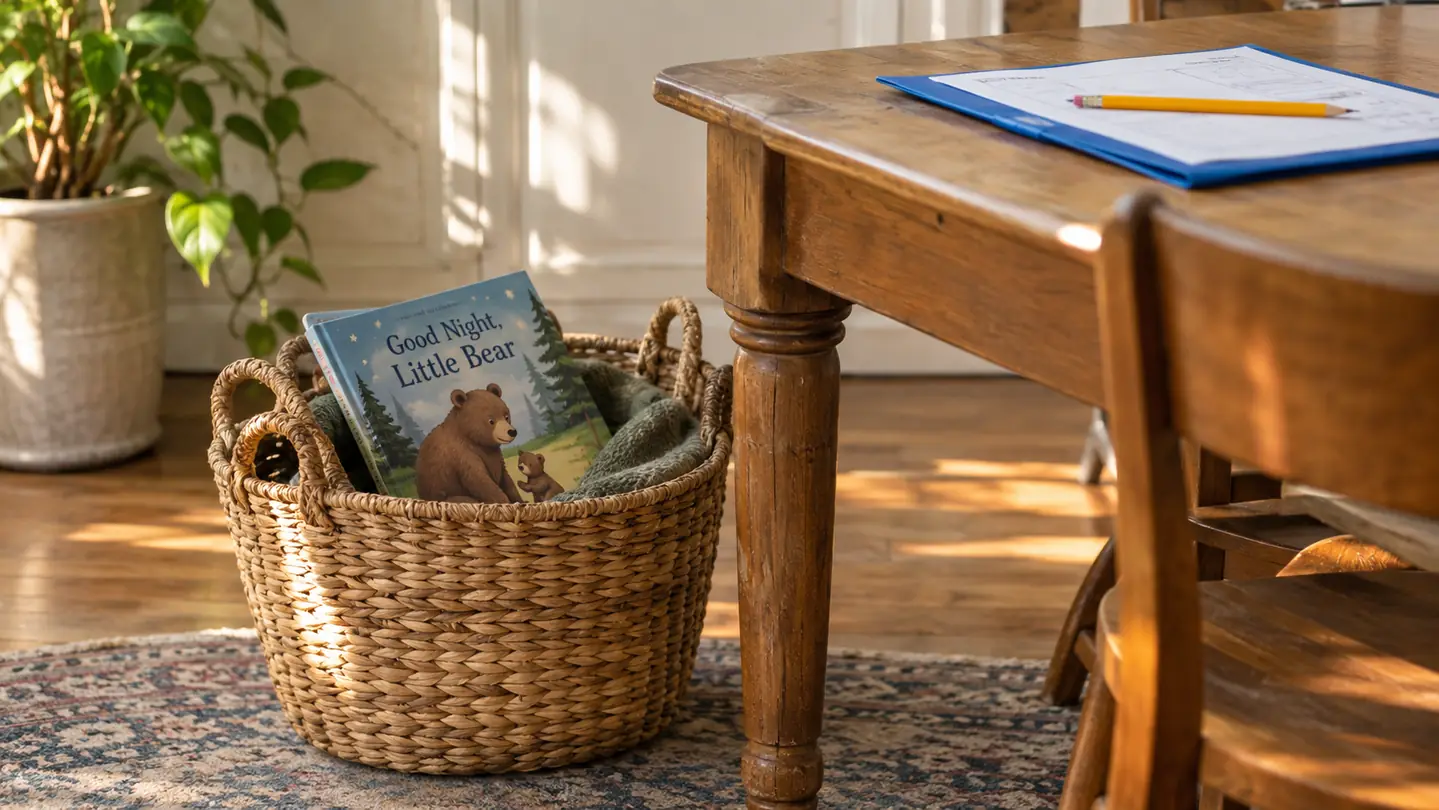
I keep it in the basket with the crayons and the reading folder, not on the shelf in Nora's room. That was on purpose. The shelf books are bedtime books. The basket books are homework books. If the book is in the basket, I remember to use it before the homework, and Nora knows what is coming. If it were upstairs, it would still be there, unopened.
Eli is ten and he is not the audience. He walked by while we were reading and said, that book is for babies. He is not wrong about his own taste. This is a book for a six year old who still sits on your lap and lets you turn the pages, and that is the child I bought it for.

What the Book Does Well
The rhyme is the reason it works as a read-aloud. DiTerlizzi keeps the lines moving, and the story stays on one idea: a child cannot do something yet, and the Yet is a friendly companion through the trying. The book does not tell a child that they will be great at everything. It says the trying is the part that counts, which is a smaller and more believable promise.
Read at our normal pace it takes somewhere between five and seven minutes, depending on how many times Nora stops to ask something. That is about the right length for the slot before homework. The rhyme carries her across pages that plain prose would lose her on. She will sit through a couplet she does not fully follow because the sound pulls her into the next line, and by then she is three pages further along than she would have been otherwise. It came out in April 2020 and holds up fine against the newer books on her shelf.
What DiTerlizzi does best is keep the promise small. The book is not about winning the spelling bee or becoming the best at math. It is about the gap between wanting to do something and being able to do it, and that gap is where most of the frustration lives for a five or six year old.
The illustrations give a child something to look at while the rhyme carries the idea. I am not going to describe the pictures in detail, because your child will see them differently than mine did, but I will say that Nora pointed at the Yet more than once and asked if it was like a little friend. That is the door the book opens. It makes the abstract idea of not yet into something a young child can picture.
The physical book is also easy to handle. It is 13.1 ounces, which is light enough for Nora to hold on her own, and the 9.38 by 10.25 inch size gives the pictures room without being a lapful. The 40 pages go quickly when you read at a normal pace.
The reading age of 4 to 8 is honest. Nora is six and it fits her. Eli is ten and he is past it. I would not buy this for a nine year old unless they still like picture books and you read it with them.
The story also gives the parent language. I found myself saying, you cannot do it yet, instead of, you will get it, which can sound like a promise I cannot keep. That shift is small, but it changed how I talked to Nora about hard things. It also gave me a way to talk to Eli without sounding like a motivational poster.
Where It Stumbles
It runs long for a tired kid. The rhyme is not long, but the story has a build, and on a night when Nora was already melting down, this was not the book that saved us. It was the book that made her say she did not want to read. I learned to skip it on those nights and pick it up the next morning instead.
Our worst read of it was a Thursday in March, a day when she had been up since six, had a substitute teacher, and came home without one mitten. She got two pages in and said the book was boring, which in our house is her word for tired. I closed it, we did the worksheet badly, and we went to bed early. The next morning she asked for it before I had my coffee poured. That pattern has held for ten months, which is why this is a before-homework book here and not an evening one.
The magic idea needs explaining the first few times. A child who takes things literally may ask who the Yet is, where it lives, and why it is there. That is not a flaw in the book, but it is work for the adult. If you are not willing to stop and talk, the book is just a story about a floating creature.
It is also not a solution. I want to be clear about that. Nora still says I can't. She said it last week about a math worksheet. The book gave us language, not a cure. If you are looking for a book that will make your child stop saying I can't, this is not that book, and I do not think that book exists.
The book also assumes a child who is willing to sit. If your child is in the middle of a growth spurt, a bad day, or a phase where every book is boring, this one will not break through by itself. It is a good book on a normal night, not a rescue book on a hard one.
I also would not use this as a bedtime book. The rhyme is gentle, but the idea is a conversation, and a conversation at bedtime is a stall tactic. We tried it once at night and Nora asked three questions about the Yet and then wanted water. It is a homework book in our house.
What Changed at Our Table
The change I noticed first was not confidence. It was vocabulary. Nora went from I can't to I can't yet in about two weeks, and that small word did something to the conversation. When she said I can't, the conversation was over. When she said I can't yet, there was a next sentence, and the next sentence was usually about what she could try.
The second change was that she started to catch herself. She would say I can't, then pause, then add yet, and look at me. That pause is the whole thing. It is the moment between giving up and trying, and the book gave her a name for it.
The moment I remember most is a February afternoon and the letter g. She could not get it to sit on the line, and she said I can't, and then she stopped and said, I can't yet, and picked the pencil back up. She did not get the g right that day. She got it a couple of weeks later in the middle of something else, without mentioning it. I am not going to pretend the book did that. But the word was sitting there when she needed it, and that is what I bought it for.
I do not want to oversell this. She is six. She has good days and bad days. The book is not the reason she reads better or tries more. It is one of the tools we use, and it is the one that fits in the basket by the table.
The book also did something for me. It gave me a script for the moments when I used to say, just try, and get nowhere. Now I say, you cannot do it yet, and the sentence has a door in it. That is not nothing.
What I Liked
- Rhyming read-aloud that holds a six year old's attention
- Gives kids a word to use after I can't
- Fits the 4 to 8 reading age and preschool to third grade level
- Light enough for a child to hold at 13.1 ounces
- Opens a conversation about trying without promising a child will be great at everything
Where It Falls Short
- Runs long on a tired night
- The magic companion needs explaining the first few times
- Not a solution for a child who is already frustrated
- Too young for most ten year olds
About two weeks in, Nora started saying 'I can't yet.' Not every time. Some of the time. That small word did more than any pep talk I tried.
Who This Is For
This is for the parent of a four to eight year old who says I can't and means it. It is for the kid who gives up before they start, not because they are lazy but because the gap between what they want to do and what they can do feels too wide. It is for the family who reads picture books together and wants one that starts a conversation instead of ending one.
It is also for the parent who is willing to stop and explain. The book does not do all the work on its own. The first few reads are a conversation, and the parent is half of it.
If you have a child in preschool through third grade who is learning to try, this is a good fit. If you have a child who is already reading on their own and does not want to be read to, this is not the book you need.
Who Should Skip It
Skip it if your child is nine or older and has moved past picture books. Eli is ten and he rolled his eyes at this one. He is not the audience.
Skip it if you want a book that will fix the problem without you. The Magical Yet is a tool, not a treatment. It works best when an adult reads it with the child and talks about it.
Skip it if your child is already wound up at bedtime. This is a homework-night book in our house, not a bedtime book. It asks for attention, and a tired kid does not have it to give.
Skip it if you want a book your child can read alone. This is a read-aloud for a young child, and the value is in the conversation around it.
A small word for the kid who says I can't
If you want a picture book that gives your child a second word after I can't, The Magical Yet is the one I have used for ten months. Read it before homework, not after.
Amazon Check Today's Price on Amazon →