
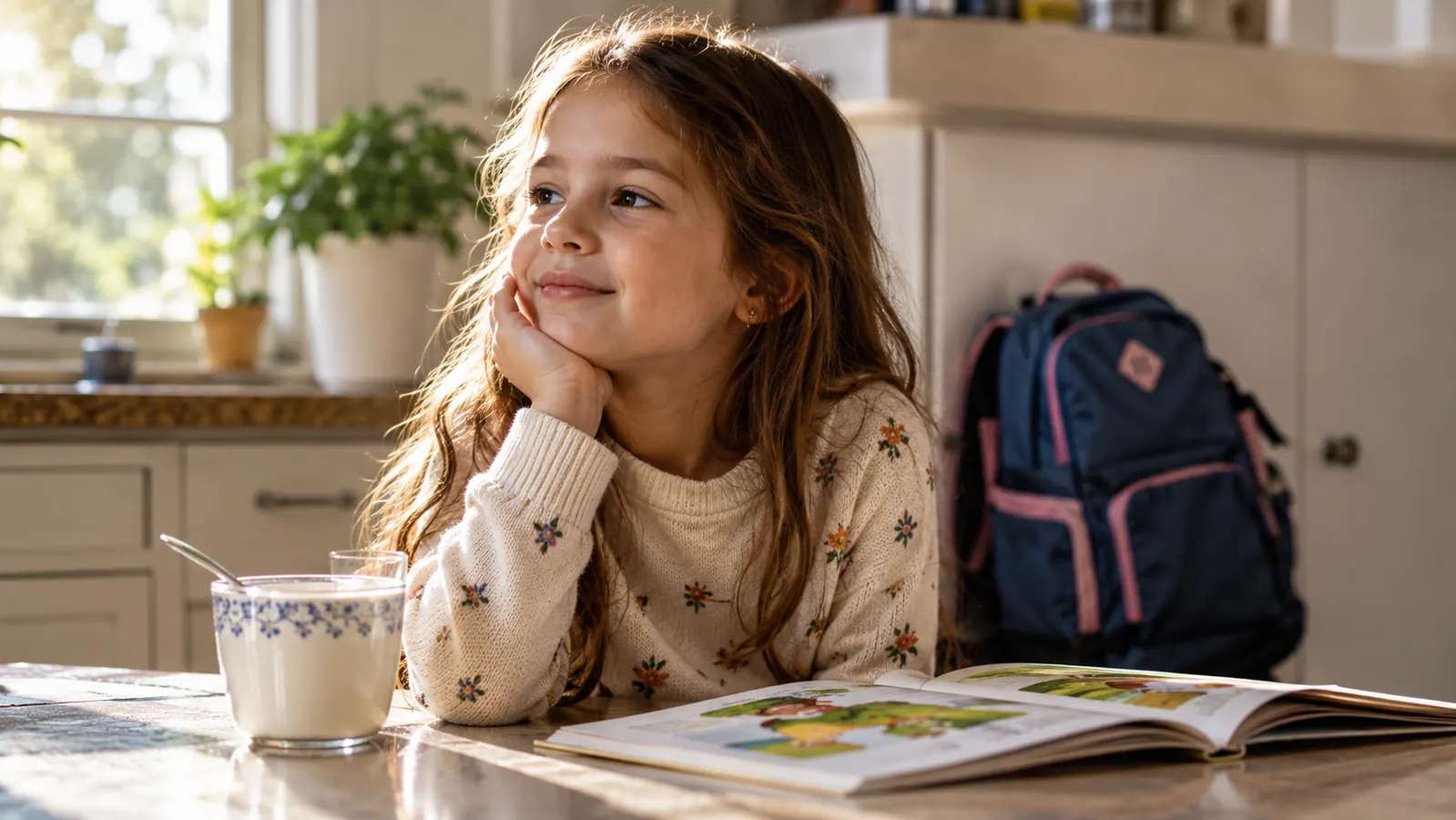
I bought this book the week before my daughter Nora started first grade, and I want to be honest about why. Not because a teacher suggested it and not because anyone handed me a list. I bought it because Nora had spent most of kindergarten saying some version of 'I can't' about anything new, and I was three days away from walking her into a building she was nervous about. I wanted something I could put in front of her at breakfast that would make the morning easier. That is a lot to ask of a picture book, and I knew it while I was clicking buy.
I Can Do Hard Things is by Gabi Garcia, illustrated by Charity Russell, and it is listed for ages 3 to 7. Thirty six pages, about eight and a half inches square, light enough that a small kid can hold it up while she eats. It is a book of short affirmations about getting through hard moments. There is no story in it. Nobody to follow from page to page, no problem that gets solved by the end. That single fact is basically the whole review, because everything I like about this book and everything I do not comes from it.
The Quick Verdict
A short, calm book of affirmations that earns its place in a school morning routine and does very little at any other time of day.
Amazon Check Today's Price →Four minutes at the counter, before the day gets loud
Thirty six pages, listed for ages 3 to 7, short enough that a nervous six year old will actually reach the end of it before the cereal goes soft.
Amazon Check Today's Price on Amazon →What This Book Is, and What It Is Not
What you have here is a short collection of sentences a child can say about themselves, with pictures, arranged to be read in a few minutes. No plot. Which means there is nothing to lose the thread of if you skip a week, and nothing that builds the way a story builds if you read it every single day. That cuts both ways and I will get to the cutting.
What it does well is scale. Thirty six pages sounds heavy until you see how little text sits on each page. Nora is six. She can hold it, turn it, and reach the end before her cereal goes soft. For a kid who is already wound tight at 7:40 in the morning, that matters more than good writing. A book that takes twelve minutes does not get opened on a school morning. This one takes about four.
I measured it, because I am that person. Eight and a half inches square and a quarter of an inch thick, listed at eleven and a quarter ounces, light enough that a six year old can hold it up one handed while she eats. Garcia's publisher, Skinned Knee Publishing, put it out in September 2018, which means the reviews on the listing have had years to settle, and reading through them before I bought was the thing that actually decided it for me. Thirty six pages, and I want to be precise about what that means in practice. We counted once, out of curiosity, and it works out to roughly one sentence a page, some pages with a little more. The page count reads generous on a listing. In your hands it is a slim book.
What it does not do is carry anyone. My son Eli is ten. He looked at it once, told me it was for babies, and went back to his toast. He is right, for him. This sits with the younger end of that three to seven range. Garcia builds for the kid who needs one sentence and a picture, not a chapter, and there is not much tucked in here for a child who is already reading on his own.
How I've Actually Used It
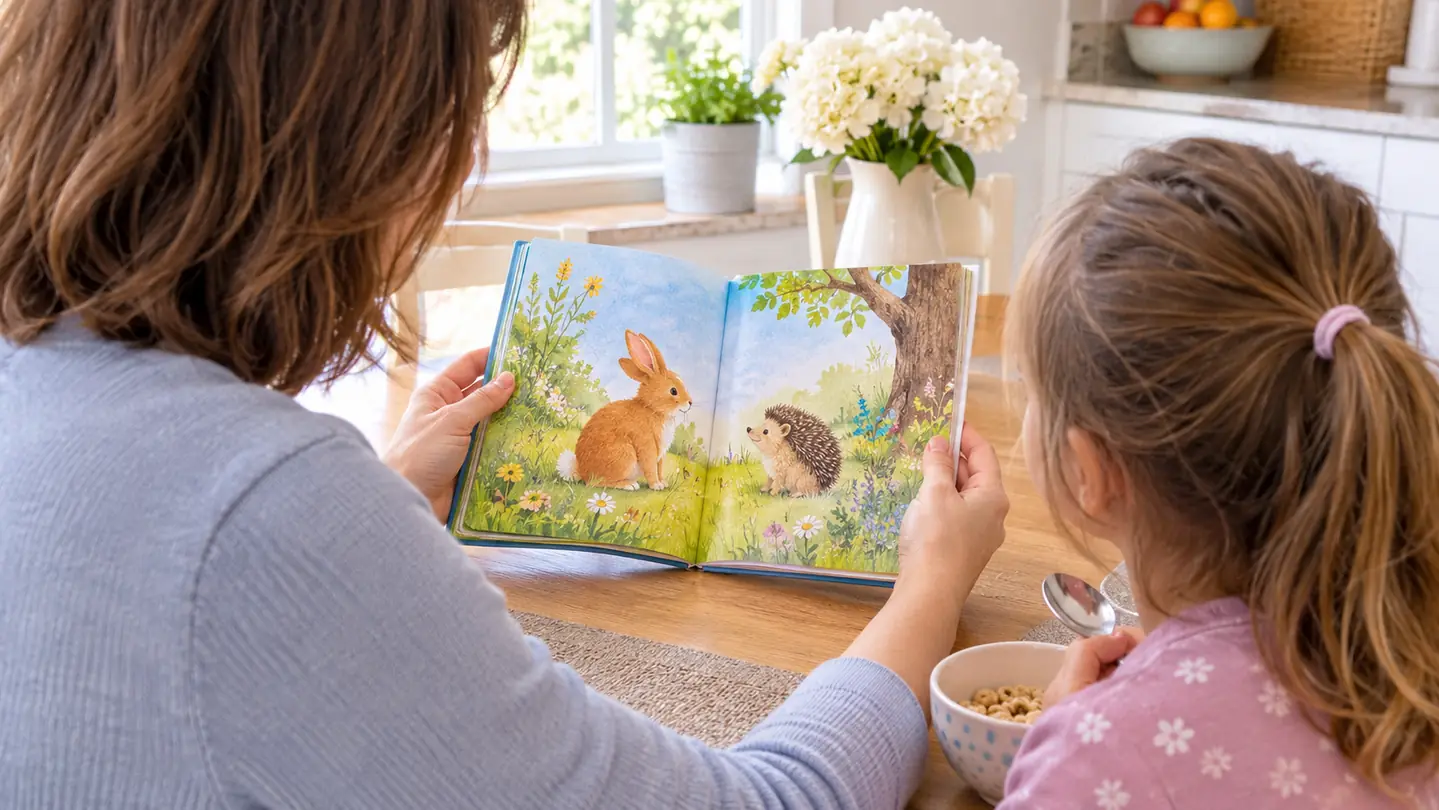
It lives on the kitchen counter next to the fruit bowl, which is the only reason it gets opened. If it lived on a shelf in Nora's room we would read it at bedtime, and it is not a bedtime book. I read a few pages with her at breakfast, about three mornings a week. Not every morning. Some mornings are a shoes-and-backpack emergency and nobody reads anything, and I have stopped feeling bad about that.
On the first day of first grade she was still nervous. She held my hand the whole way to the door, and then she walked in. I am not going to claim a book did that. She is six and she did it, and there was a knot in my stomach too. What the book gave us was ten minutes at the counter before any of that, while the day was still small enough to talk about. It did not remove the nerves. It gave me a way into the conversation, which is a smaller thing and a real one.
Before the counter, I tried it at bedtime, and it died in about a week. Bedtime in our house belongs to stories. Nora wants the one with the bear and the one where the bird gets cross, and a page of affirmations at 8:15 at night landed like a bath before the bath was over. I gave it three or four nights, she squirmed through two pages each time, and I put it down. The counter worked because breakfast is the one part of the day where she is sitting still with nothing to do but wait for me to finish my coffee. Location did more than enthusiasm did.
I also tried a sticker chart, which lasted four days. Every morning she read a page she got a sticker, and by day five she was reading one page fast to get the sticker, and I was the one enforcing it. That is the opposite of what the book is for. I dropped the chart and stopped counting. Three mornings a week, no reward, and if we miss a week because of a dental appointment or a late night, we miss a week and nobody has failed. I know that is not a system anyone could put on a parenting blog. It is just what held.
The timing matters more than I expected. Ours is somewhere between 7:35 and 7:45, after teeth and before shoes, and the window is narrow. Open it too early and she is not awake enough to care. Open it too late and we are already in the countdown and she can feel it in how I am moving. Two mornings last month we never opened it at all and the mornings were fine, which is the honest way to describe a book like this. It is a small good thing in a slot that had nothing in it before.
Three months in, the honest summary is that this is a routine, not a cure. She said 'I can't' about a zipper last week. She says it less at breakfast, and I think that has more to do with repetition than with any particular page. If you have ever heard a six year old sing a jingle she heard twice, you know how much a short repeated line can stick.
This is a routine, not a cure, and the distance between those two words is the entire review.
What Nobody Tells You About Affirmation Books
The first thing is that these sentences are written as things a child says about herself, which makes reading them aloud a strange act. The first few times I read it the word I felt wrong in my mouth, because I was saying it about me and saying it to her at the same time. So I started handing the book over and letting her say the line, or saying it along with her. It is a small change. It changed the book completely. Handed over, it belongs to her. Read at her, it is a lecture with pictures.
The morning that taught me the most was a Tuesday in September, second or third week of school. Nora came down already upset about something at the bus stop that had not happened yet, and I opened the book and started reading at her in my best calm voice, and she put her hand flat on the page and said, not that. Which stung, and was also correct. The problem was not the book. The problem was that I was using it on her. The next morning I set it open on the counter and said nothing at all. She read two pages while I made toast and then talked about something else entirely. The book worked when I got out of the way of it.
There is also a tone problem nobody warns you about. Read these sentences in a bright sing song voice and they land like a slogan off a cereal box. Read them flatly and they land like a chore. The voice that works in our house is my normal talking voice, the one I use for the grocery list. That took me about a month to work out, and I am telling you now to save you the month.
The second thing is that a book like this turns into a chore faster than you would expect, and a chore gets dropped. Ours survived because of where it sits and how long it takes, not because we are disciplined people. I own a shelf of things we meant to keep doing. The four minute book on the counter is the one that stuck, and I do not think that is a coincidence.
The third thing is that it cannot carry a bad hour. If the rest of the morning is yelling about shoes and a lost glove, four pages of affirmations is a nice moment bolted onto a bad twenty minutes, and kids notice the gap. This works in our house because the mornings are mostly calm now. When they were not, it did very little, and I would rather tell you that than sell you something.
What I Liked
- Short enough to actually finish on a school morning, about four minutes
- Light and small enough that a six year old can hold it herself
- Simple enough that you can hand it to the child instead of reading at her
- No prep, no materials, no extra time in the morning
- The 3 to 7 reading age listed on Amazon matches how it actually reads
Where It Falls Short
- No story, so it holds nothing on a tired or wiggly day
- Very little text for the page count
- Nothing in it for a child past seven or so
- A five year old will not start it alone, an adult has to open it first
- Depends on the rest of the morning being roughly calm
What Fell Flat
It is thin. I do not mean short, exactly, I mean there is not much to it. Some mornings we read the whole thing and Nora closes it and asks, so that is it? Thirty six pages of very few words goes by fast, and the page count reads more generous on a listing than it feels in your hands.
There was a Sunday in October where I tried it after a rough afternoon. Nora had a meltdown over a puzzle, real tears on the kitchen floor, and I thought, this is what the book is for. I got it out and read two pages and she cried harder, because what she wanted was to be held and not to be handed a sentence. That is the thing I keep coming back to. A short book of affirmations is a decent tool for a small feeling in a calm moment. It is not a tool for a big feeling, and if you reach for it during a big feeling it will fail and you will blame the book for it.
It has no story, and on a night when she is tired it has nothing to hold her. We borrowed a library book once, Don't Feed the WorryBug, and she asked for it again the next night, and I think she asked for it again because something happens in it. Nothing happens in this one. That is the trade you make for the calm, and some kids will not make it.
The older child problem is real. Eli is past all three of the picture books on our shelf and he rolls his eyes at this one. If you have an eight or nine year old who is struggling with the same I can't talk, this is not the book for them. Garcia writes for the small end. The listing says three to seven and the listing is telling the truth.
The book that got read on the mornings it mattered
A few pages at breakfast, three mornings a week, for three months. That is the whole method, and it is the reason this one stayed on the counter.
Amazon See It on Amazon →
Who This Is For
Parents of a four to six year old who has started flinching at new things. The kid who says she is not good at it before she has tried it. The kid who needs a minute and a calm voice more than she needs a pep talk. If that is your child, this slides into a morning routine easily because it asks almost nothing of the morning.
Grandparents, too. My mother in law is in Columbus and she asks me what to send. This is a safe one for a five year old, partly because it does not require the adult to be good at talking about feelings. You open it, you read it, you are done. There is no script to learn and no conversation you have to steer, which is worth more than it sounds if you are the grandmother and you are not sure what to say.
Who Should Skip It
If your child is seven or older, skip it. If you want a story with a character your kid will ask for again, skip it. If the struggle in your house is worry that keeps a child up at night rather than a flinch at new things in the morning, this is the wrong tool and something with an actual story would serve you better.
And if you are hoping a book will do the work on its own, skip it. Nothing on a page changes a morning unless somebody opens the page, and that somebody is you, at 7:30, with a bowl in the other hand. The book is the easy part.
What I'd Tell You at My Kitchen Table
If you were sitting across from me right now I would tell you to buy it if your kid is five or six and the word can't has gotten into everything. I would tell you to leave it on the counter, not the shelf, and to hand it over instead of reading it at her. And I would tell you not to expect a different child by October. Three months in, what changed in our house is smaller than that and better than that. Nora still has rough mornings. She just has a few sentences for them now, and so do I.
Thirty six pages, ages 3 to 7, and one calmer morning at a time
It will not fix anything. It will give you four minutes and a way into the conversation before the day starts, which in our house was the part I could actually control.
Amazon Check Today's Price on Amazon →