

Nora was five the first time I heard her say it. She was at the kitchen table with a phonics worksheet in front of her, pencil down, chin propped in her hand, and she said it flat, with no drama at all: I can't do it. I'm not good at it. Not crying. Not throwing anything. Just a small person announcing a conclusion she had already reached about herself.
That was kindergarten. She is six now, in first grade, and the sentence still shows up, usually on reading homework nights. I tried the obvious things first. I told her she could do it. I told her to try again. I told her that nobody is good at anything the first time, which is true and completely useless when you are six and the worksheet is already on the table. What actually changed the temperature in our kitchen was a picture book. The Magical Yet, by Angela DiTerlizzi, is a 40 page rhyming picture book published by Little, Brown Books for Young Readers, written for roughly ages 4 to 8 and rated preschool through third grade. I am not going to tell you it fixed my kid, because it did not. What it did was hand us a word we could both use, and that turned out to be worth more than every pep talk I had tried.
One small word did more than a year of pep talks
The Magical Yet gave my six year old a way to say I can't do this without it being the end of the sentence. It is a 40 page read for ages 4 to 8, and in our house it lives in the basket by the kitchen table.
Amazon See The Magical Yet on Amazon →Five Steps That Made a Difference at Our Table
Step 1: Read it before the hard thing, not after the meltdown
The first change was timing, and if I could keep only one step it would be this one. For the first couple of months I did what felt natural, which was to reach for the book after a frustration, when Nora was already upset and I was already worn down. It never worked. A book that shows up after a meltdown reads like a punishment dressed up as a story. She would sit with her arms folded while I read, and I would close the cover feeling worse than when I opened it.
Now we read it before. On homework nights, which for us are Monday and Wednesday, I take it out of the basket by the table, we read it together, and then the worksheet comes out. It takes under ten minutes and it sets the tone instead of trying to repair it. Nora goes in calmer, and so do I, which matters more than I expected it to.
There is a plain reason this helps and it has nothing to do with the book being enchanted. When she hears the idea before she is frustrated, it is already in her head when the frustration arrives. When she hears it afterward, she has to learn something and calm down at the same time, and that is a lot to ask of a six year old with a pencil in her hand.
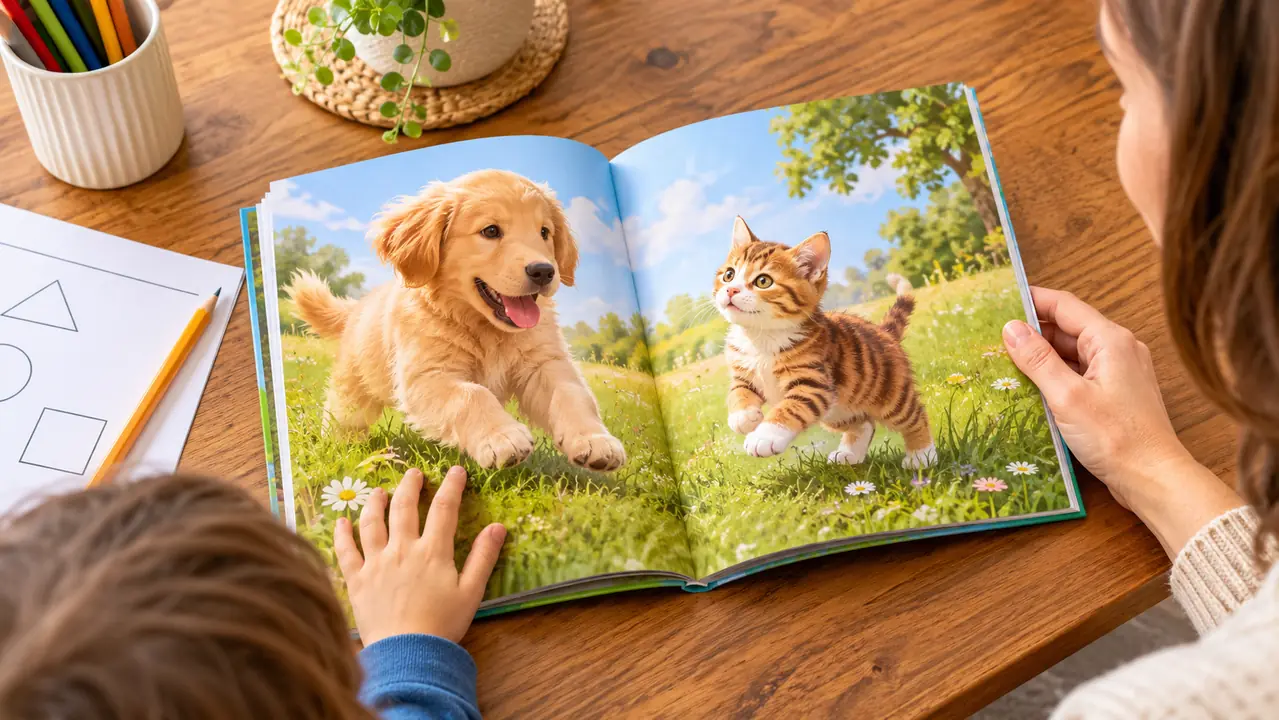
Step 2: Ask which part is hard, and let the answer be small
Before I open the book I ask one question. Which part are you worried about? Not why are you upset, and not you will be fine. Which part. Sometimes she says the writing part. Sometimes it is one specific word she is sure she will get wrong. Sometimes she shrugs.
The shrug is fine. The question is doing the work either way, because it treats the frustration as information instead of a behavior problem. It also means the story lands as an answer to something she actually said, rather than a book mom produced because mom decided it was time for a lesson.
DiTerlizzi does not ask a child to explain herself anywhere in those 40 pages, which is part of why I trust it. There is no lecture and no note to parents at the end. It shows a child who cannot do something yet, with the Yet beside them as a friendly companion, and then it lets the idea sit there. My one question before the read is the only place any explaining happens, and it takes about fifteen seconds.
Step 3: Read it twice, once for the story and once for the word
The first read is just a read. Rhyme, pictures, no interruptions from me. Nora is six and she wants the sound of the words, and if I stop on the second page to make a point she knows immediately that she is being taught something.
The second read is slower. This is where the word yet picks up weight, and it is where I stop and let her finish the sentence herself. It took three or four reads before she started doing that. The companion also needed explaining the first few times. Is it a person, is it a pet, is it a ghost. I told her honestly that I thought it was the idea of yet wearing a costume, and she accepted that and moved on.
One honest note about DiTerlizzi's book. It runs long for a tired kid. Forty pages of rhyme at the end of a long day is a lot to ask, which is exactly why it lives in the homework basket and not on the bedtime shelf. Bedtime in our house belongs to a different, much shorter book, I Am Enough by Grace Byers, and it is short on purpose.
The book did not make my daughter braver. It gave her a word short enough to say while she was still frustrated, and that is the whole trick.

Step 4: Use the word yet about yourself, out loud, where she can hear it
This is the step that moved fastest, and I did not see it coming. I started saying the word about myself, out loud, in the kitchen, not aimed at her. I cannot get this printer to work yet. I do not know this recipe yet. I have not figured out the new schedule at work yet.
Within about two weeks of that, Nora began adding yet to her own sentences, some of the time. I want to be careful with that phrase, because some of the time is the honest version. She still says I can't do it with nothing on the end, and she said it last week at the table. But she also says I can't do it yet now and then, and when she does it belongs to her. She is not repeating a line from a book to make me happy.
Children copy what they hear far more reliably than what they are told. If the word only ever comes out of the book, or out of my mouth as a correction, it stays a book word. Once it is something the adults in the house say about their own small failures, it becomes ordinary, and ordinary is the goal.
Step 5: Stop at the first small try and name it out loud
After the book I ask for one line. Not the whole worksheet. One line. When she does it, I describe what I saw rather than praising her. You did the first one. That was the try. Not good job, which is really about me being pleased, but a plain account of the thing she actually did with a pencil.
This is the step where the book either becomes real or stays a nice story. A child who reads about the Yet and then gets told to finish the entire page has learned that the word is for books. A child who reads about the Yet, does one line, and hears it named has learned that the word is for her.
I will say the obvious thing, which is that this does not work every time. Some nights she does the one line and melts down anyway, and there have been a couple where I sent her to bed feeling like I had handled it badly. She is six. The point was never the worksheet. The point is that the word is in her mouth now, and it will still be there when the work gets harder in a few years.
What Else Helps
A few small things I would pass along. Keep the book where it is easy to reach. Ours sits in a basket beside the kitchen table, not on a shelf where it would feel like medicine. A book a child can pull out herself gets opened for her own reasons, and that beats being prescribed.
Do not turn it into a consequence. I made that mistake in a week when homework had gone badly, and I heard myself say we were going to read it again, and it came out sounding like a sentence. It took a couple of weeks to make the book feel normal again. Once a story is part of the discipline, it stops being useful.
Read the room on age. The listing puts the reading age at 4 to 8, with a preschool to third grade level, and that matches what I watched. My ten year old son Eli is well past it and rolls his eyes at all three of the picture books in this house. A nine or ten year old who is stuck on something needs a different tool, and for Eli that was You Are Awesome, written for ages 9 to 12, which argues that practice and mistakes build skill.
If the frustration is bigger than a worksheet, a picture book is not the answer. I am a mom, not a counselor, and I am not going to pretend that forty pages of rhyme handles everything. When a hard day turns into a hard month, the right move is a conversation with your child's teacher or doctor, not another book from me.
Two other books came through our house in the same stretch, and both are worth knowing about. I Can Do Hard Things by Gabi Garcia is a set of short affirmations for ages 3 to 7, and it is what Nora gets at breakfast on school mornings. It is thin and it has no story, but it is fast, and fast is what a school morning requires. I Am Enough by Grace Byers is Nora's bedtime book and takes under five minutes. I also borrowed The Dot from the Dayton library to see how it compared, and I wrote a longer, more detailed review of The Magical Yet if you want the fuller picture of how we use it here.
If your child says I can't before she has even tried, start with the word
Our copy has been in the basket by the table for ten months and it is still in rotation. It will not fix a hard week, but it gives you both something to say in the middle of one.
Amazon See The Magical Yet on Amazon →