

The first thing nobody tells you about I Am Enough is that the subtitle calls it a story, but at our house it has never worked like one. Grace Byers wrote a short rhyming poem about liking yourself, being kind, and respecting other people. There is no character to follow, no problem to solve, no page where something goes wrong and gets fixed. That is not a criticism by itself. It is the fact that decides whether the book fits your child. I am Lorna Beckett, I live in Dayton, Ohio, and I have read this book to my daughter Nora about three nights a week since September 2025. She was five when we started. She is six now, in first grade, and the book still lives on her shelf. I bought our copy myself. Nobody sent it to me, and nobody asked me to like it.
Here is what I want to tell a parent standing in a bookstore or scrolling an Amazon listing. This is a book you read with a child, not a book you hand to a child and walk away from. Byers gives you the words and the tone. The parent supplies the story, the examples, and the pauses. If you are looking for a picture book that carries a bedtime routine on its own, with a plot that pulls a tired kid along, this is not that book. If you are looking for a way to start a conversation about how your child talks to herself, it can do that job, and it has done it at our house in small ways. I want to be clear about the size of those ways. This book did not change Nora's personality. It gave us a script we return to.
The Quick Verdict
A warm, short bedtime poem that opens a conversation about self-talk, kindness, and respect. It is not a story, and it will not hold a wiggly child without you.
Amazon Check Today's Price →If bedtime needs kinder words, this is the book I reach for
I have read this to Nora about three nights a week for 14 months. It takes under five minutes, and it gives us a place to start talking. See the listing for yourself.
Amazon See it on Amazon →How This Book Ended Up in Our Bedtime Routine
I bought I Am Enough in September 2025, when Nora was five and had started saying I can't about almost anything new. Kindergarten had just started, and she was cautious in the way a small child is cautious when the room is bigger than she expected. I was not looking for a cure. I was looking for better words at bedtime than you're fine and don't say that. I wanted something we could read together that did not feel like a lecture. The book was short, the listing said it was for ages 3 to 7, and the cover looked calm. That was enough for me to try it.
The book is 32 pages, listed for reading age 3 to 7 and grade level preschool to 3. Ours is the illustrated edition from HarperCollins, published March 6, 2018. The listing gives dimensions of 10.1 by 10.1 by 0.6 inches and a weight of 14.7 ounces. That matters at bedtime because Nora can see the pages from her pillow, and I can hold it open with one hand while I sit on the floor beside her bed. It takes under five minutes if I read it straight through. It takes longer if we stop, which we usually do.
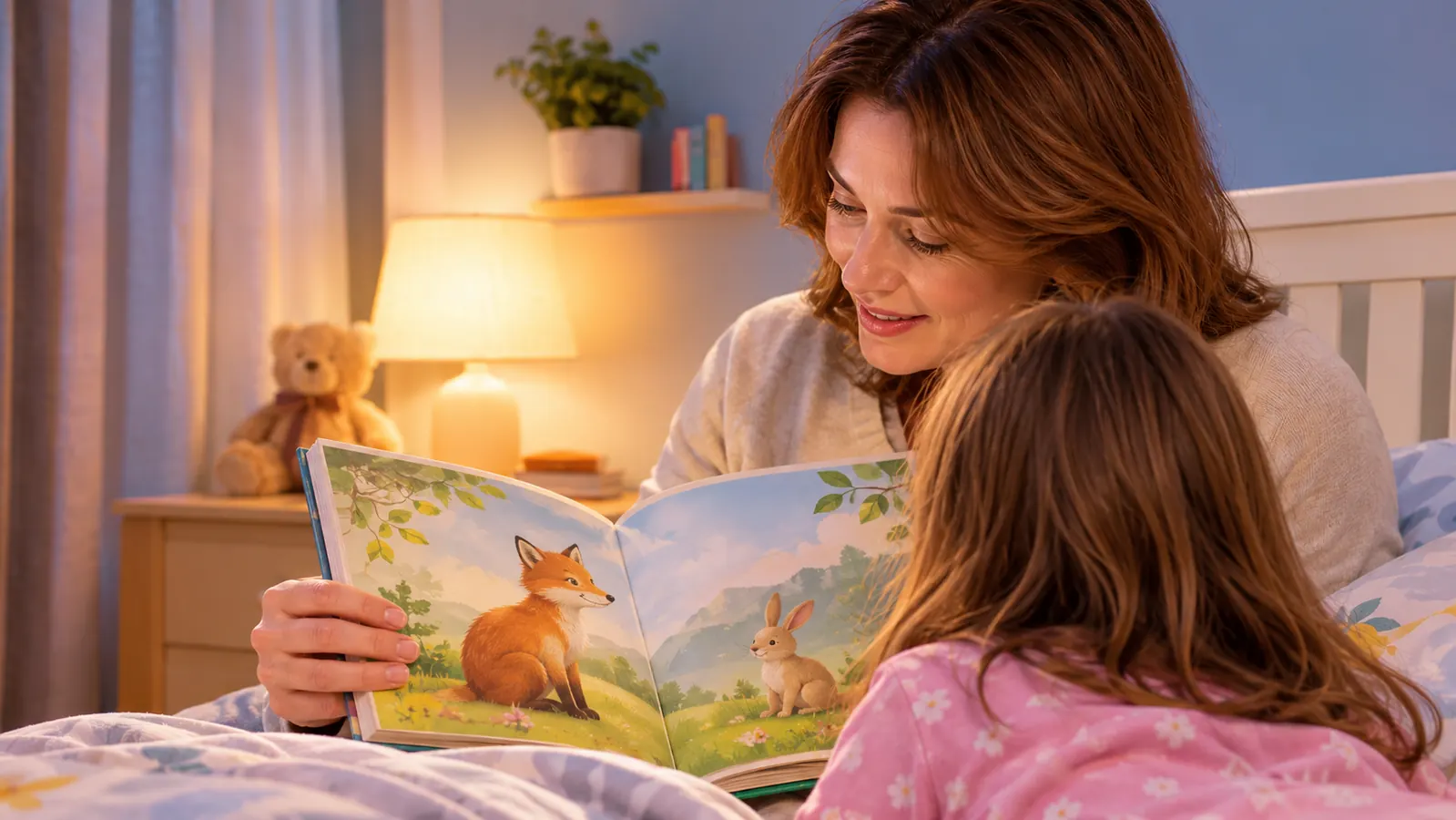
The routine is simple. Nora picks it about three nights a week. We read it in her room, after teeth and before lights out. She knows the rhythm now. I do not make her repeat the words back to me. I do not turn it into a lesson. I read, she looks at the pictures, and sometimes she asks a question. That is the whole practice. It is small, and I have come to think small is the right size for a bedtime book.
What Nobody Tells You: It Is a Poem, Not a Plot
The subtitle says story. I would call it a poem. Byers writes in rhyme, and the lines are about liking yourself, being kind, and respecting others. There is no girl who loses a game, no boy who gets laughed at, no arc. That makes the book flexible, and it also makes it slippery. A child who needs a narrative to stay engaged will not get one here. A child who likes language, repetition, and talking back to a parent will do better.
The poetry is not simple in the way a nursery rhyme is simple. Some of the ideas are abstract for a five year old. I have had to stop and say what a line means in plain words. I have had to give examples from Nora's day. Remember when you helped your friend find her shoe. Remember when you kept trying with the zipper. I do not quote the book here because I do not want to pull lines out of context. The point is that the book gives you a topic, not a full explanation. The parent has to translate.
This is the part I would want to know before buying. If you are not willing to talk during the read, the book will be over in under five minutes and very little will happen. If you are willing to pause, ask one question, and let the answer be short, it can open a door. It is a mirror and a prompt. It is not a workshop, and it is not a cure.
The book gives you the words. The parent supplies the story, the examples, and the pauses.
The Small Thing That Happened by Thanksgiving
I did not expect a result I could point to. I bought a book, not a program. So I noticed the first small thing because it was unusual. By around Thanksgiving 2025, Nora sometimes said something kind about herself without being asked. Not every day. Not in a big voice. Something like I did that okay after she put her shoes on by herself, or I am getting better at this about a puzzle. I cannot prove the book caused that. I can tell you it started during the months we were reading it, and the language in the book is about liking yourself and being kind. That is the honest version.
I also noticed what did not happen. Nora did not start announcing affirmations in the mirror. She did not become a child who never says I can't. She still says it. She said it last week about a zipper. The book did not remove the reflex. It gave us a reference point. When she says I can't, I can say, that is a hard thing, what would the book say. She rolls her eyes sometimes. Sometimes she answers. That is the whole return on investment. A small opening.
I think this is where a lot of reviews get slippery. A parent reads a book for a month, the child says one nice thing, and the review says the book built confidence. I do not know that. I know Nora has a phrase in her head that she did not have before. I know I have a way to answer her that is not a lecture. That is enough for me to keep it on the shelf. It is not enough for me to promise it will do the same for your child.
Where It Falls Flat on a Wiggly Night
The main weakness is the one I keep coming back to. There is no plot. On a calm night, that is fine. On a wiggly night, it is a problem. Nora has nights when she cannot settle, when she is overtired, when the day was too loud. On those nights, a poem about self-love is not what she wants. She wants a story with a character and a problem. She wants to be carried. This book asks her to sit with an idea. Sometimes she can. Sometimes she cannot, and I put it away.
The second weakness is the language. The rhyme is pleasant, but some lines are more abstract than a five year old's everyday talk. I have read a page and watched Nora's face go polite. That is the face she makes when she is waiting for me to explain. If I do not explain, the book becomes background sound. If I do explain, the bedtime routine gets longer. Neither is a disaster. Both are work.
The third weakness is age range. The listing says reading age 3 to 7 and grade level preschool to 3. That feels right to me, with a caveat. A three year old may enjoy the sound and the pictures and understand very little. A seven year old may understand the ideas and feel too old for the format. Nora is six and still asks for it, but she is also the child who likes to talk. A child who is past picture books will not come back to this one. Eli, my ten year old, is past it. He rolls his eyes at the three picture books on Nora's shelf, including this one.

How I Read It So It Lands Better
I read the title, then the page. I do not rush. I stop at the end of a spread and ask one question, not five. Does that sound like you. Or, who were you kind to today. One question is enough. If she says I don't know, I let it go. The goal is not a correct answer. The goal is a few seconds of thinking.
I connect it to something real from her day. The book is general. Her day is specific. If she shared a toy with a friend, I bring that up. If she got frustrated with her shoes, I bring that up. This is not a technique from the book. It is just what makes the book useful for us. Byers gives the frame. I fill in the details. Without the details, the frame is pretty but empty.
I keep it short. Under five minutes is the right length for bedtime. If we have had a hard day, I read it straight through and skip the talk. If we have had a good day, we linger. I do not use it as a punishment or a lesson after bad behavior. That would make it feel like a lecture, and Nora would shut down. It is a bedtime book, not a consequence.
I also let her see me read it. I do not mean that in a sentimental way. I mean I sit on the floor, I hold the book, I say the words out loud. She sees that the words are not just for her. They are for the room. That seems to matter more than any question I could ask.
What I Liked
- Short enough to finish on a school night, under five minutes if you read it straight through
- The rhyme gives a child language for self-talk, kindness, and respect without sounding like a worksheet
- The 10.1 by 10.1 inch format is easy to see from a bed and easy for a parent to hold open
- It opens a conversation without requiring a child to write or perform
- The message includes kindness and respect for others, not just liking yourself
Where It Falls Short
- No plot, so it does not carry a wiggly or overtired child
- The poetry is abstract in places and needs a parent to stop and explain
- The subtitle says story, which sets an expectation the inside does not meet
- It is not a fix for anxiety, big feelings, or a child who is struggling in a clinical way
- Older children in the 7 to 9 range may feel too old for the picture book format
- The book asks the parent to do the interpreting, so it is not a hand-off read
Who This Is For
This is for a parent or grandparent who already reads aloud and wants a short book that starts a conversation about how a child talks to herself. It fits a child roughly 4 to 7 who will sit for a poem and likes to ask questions. It fits a family that is willing to pause and give examples. It fits bedtime, not homework. It also fits a parent who wants the message to include kindness and respect, not only self-esteem. If you are already reading picture books and you want one more tool for the shelf, this is a reasonable one.
It is also a good fit for a child who is starting to say I can't about new things, not because the book will stop that, but because it gives you a different script. Nora was five when we started, and the book met her where she was. A six or seven year old who still likes picture books can use it too. The key is that the child will sit with you. If the child is already rolling her eyes at picture books, this is not the one that will bring her back.
Who Should Skip It
Skip it if you need a story with a plot. Skip it if you want a book a child can read alone. Skip it if you are looking for a clinical tool for anxiety or big feelings. Skip it if you are not willing to talk during the read. Skip it if your child is eight or older and has moved past picture books. The listing says 3 to 7, and I would take that seriously. A ten year old will not get much from it, and that is not a failure of the book. It is a mismatch.
I would also skip it if you want a book that promises a change. No book can promise that. This one is a short poem with a warm message. It is not a program, and it is not a substitute for a counselor or a teacher. If your child is struggling in a way that worries you, talk to someone qualified. That is outside what a bedtime book can do. I say that as a mom, not as an expert.
A short bedtime book that gives you a place to start
If you want a gentle way to talk about self-talk, kindness, and respect without a worksheet, this is the one I have kept on Nora's shelf for 14 months. See the current listing on Amazon.
Amazon See it on Amazon →